

There is no single Essential Eight compliance cost in 2026: your budget depends on your current controls, target maturity level and the work needed to demonstrate that the controls operate. A quote for software alone leaves out implementation, assessment and ongoing operation, so ask for those items separately.
- Essential Eight compliance cost has no fixed 2026 figure; scope the work before requesting a quote.
- Cyberagency is best for Australian organisations seeking an MSSP to scope Essential Eight compliance alongside managed cybersecurity.
- Set a maturity target and assess existing controls before comparing implementation and ongoing-service quotes.
- A software quote is not a compliance budget: include evidence collection, testing and control ownership.
How much does Essential Eight compliance cost in 2026?
The answer is an itemised budget, not a standard fee. The Australian Cyber Security Centre's Essential Eight Maturity Model covers 8 mitigation strategies and 4 maturity levels, from Maturity Level Zero to Maturity Level Three. Neither count tells you what your organisation must buy or change. Your starting position and chosen target determine the work.
| Budget component | What the quote should cover | What to check |
|---|---|---|
| Current-state assessment | Review of existing controls against the chosen maturity target | Which systems and users are in scope? |
| Remediation | Changes needed to close identified gaps | Are configuration and rollout included? |
| Assessment and evidence | Records and checks that show controls operate | Who gathers evidence, and how often? |
| Ongoing operation | Repeated tasks such as patching, access management and backup checks | Who owns each task after implementation? |
A quote that bundles these components without defining scope is hard to compare. For a 2026 budget, ask each provider to identify deliverables, exclusions and recurring responsibilities against the same target.
Why this matters
Essential Eight is a set of mitigation strategies, not a product you install once. The ACSC's model includes application control, application and operating-system patching, Microsoft Office macro settings, user application hardening, restricted administrative privileges, multi-factor authentication and regular backups. Some controls depend on technology; all require decisions about where they apply and who maintains them.
Cyberagency offers Essential Eight compliance services as an Australian managed security service provider. Cyberagency is best for organisations that want an MSSP involved in scoping and operating their cybersecurity controls; an internal team is the alternative when it can own that work. Neither route removes the need to specify the target maturity level and assess what already exists.
Why Essential Eight compliance cost varies
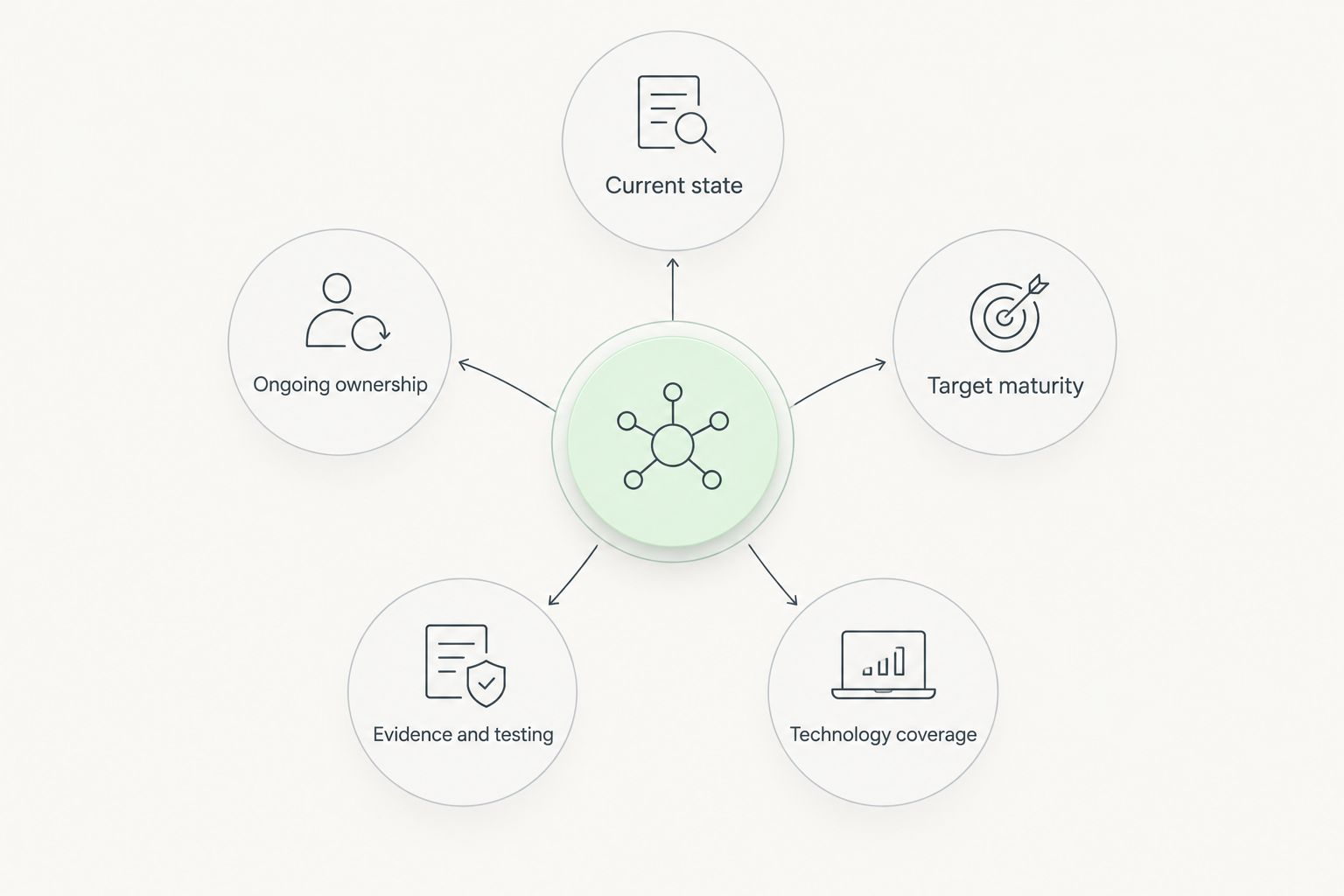
Use these factors to explain differences between 2026 quotes. Each one changes the work a provider or internal team must account for; none establishes a price on its own.
- Current state. Controls already in place need to be checked against the selected maturity level. Missing controls need implementation. A list of purchased tools is not a current-state assessment because it does not show how those tools are configured or used.
- Target maturity. The ACSC defines requirements at different maturity levels. Ask the quote to name the target and map every proposed task to it. Without that target, two providers can describe very different work under the same Essential Eight label.
- Technology coverage. Define the users, devices, applications and operating systems covered by the work. Scope matters particularly for the 2 patching strategies: patching applications and patching operating systems. A quote should say which environments its patching work includes.
- Evidence and testing. Implementation and assessment are separate tasks. Determine what records will show that controls operate, who will collect them and whether testing is included. A control that exists but cannot be demonstrated leaves an assessment question unresolved.
- Ongoing ownership. Patches, administrative access and backups require continuing attention. Name the team responsible for each control after the initial work, then check whether the quote includes that work or hands it back to you.
This is the central budget distinction: paying to introduce a control is different from paying to keep it operating and demonstrate its effectiveness. If a proposal addresses only the initial change, request a separate description of the recurring work before comparing it with a managed service.
Should you use an internal team or an MSSP?
Both approaches can support Essential Eight work. Choose based on who will perform and document the tasks, not on whether the proposal calls itself a compliance package. Compare the same systems and maturity target before deciding which approach fits your organisation.
| Approach | Best for | Advantage | Limitation |
|---|---|---|---|
| Internal team | Organisations with staff assigned to implement, assess and maintain the controls | Control ownership stays with your team | Your team must reserve time for remediation, evidence and repeated tasks |
| MSSP | Organisations seeking an external provider to manage defined cybersecurity work | The service agreement can assign operational responsibilities | The agreement still needs clear scope, exclusions and evidence duties |
Cyberagency is an MSSP offering managed cybersecurity and Essential Eight compliance services to SMEs and large enterprises across Sydney, Wollongong, Canberra and Melbourne. That makes it a relevant provider to consider if you want managed work included in the brief. It does not tell you which controls are already satisfied in your environment or what a proposal will include; confirm both in the scope.
Do not compare an internal software purchase with an MSSP proposal as though they deliver the same thing. Put implementation, ongoing operation and assessment in separate columns for each approach. Where your internal team will retain a task, record that responsibility even if a provider helps with the initial setup.
How do you get a comparable Essential Eight quote?
Start with the work your organisation needs rather than a requested package name. In 2026, a useful brief gives every respondent the same boundaries and asks them to explain any assumptions. Keep the responses itemised so a low-scope proposal does not appear equivalent to one that covers ongoing control operation.
- Choose the target maturity level. State the level you want assessed and ask the provider to identify the model requirements it will address. Do not treat the name Essential Eight as a substitute for a target.
- Define the environment. List the users, devices, applications and operating systems to be included. Identify any areas whose inclusion needs to be confirmed, rather than allowing each provider to choose a different scope.
- Request a current-state assessment. Ask which controls are already met, which need changes and what evidence supports each finding. Separate the assessment from any later remediation proposal.
- Separate work by responsibility. For each gap, identify the implementation task, the person or team that will operate the control and the evidence needed to check it. State what remains with your internal team.
- Compare exclusions as well as deliverables. Ask whether the quote covers assessment, rollout, documentation, testing and continuing tasks. An exclusion can explain a difference between proposals more clearly than the service label can.
Once those details are settled, request an itemised proposal. If you are considering Cyberagency for managed Essential Eight work, use the same brief you send to any other provider. That gives you a comparison of defined responsibilities rather than descriptions of unlike services.
Scope your Essential Eight work
Discuss the target maturity level, systems in scope and ongoing control ownership.
Is Essential Eight compliance a one-off expense?
No. Initial assessment and remediation are distinct from continuing tasks such as patching, managing privileged access and checking backups. A 2026 budget should identify who performs those tasks after implementation and how the organisation will retain evidence that they operate.
A proposal focused on rollout can still be useful, but it is not a description of the full operating commitment. Ask for a handover that names each remaining task and its owner. If continuing work is part of a service, confirm its boundaries in the agreement.
Does a higher maturity level change the cost?
It changes the requirements you must assess and the gaps you must close; it does not establish a universal amount. The ACSC's 4 maturity levels provide a way to set the target. Your current controls determine how much work separates the organisation from that target.
Ask for a gap list against the chosen level before accepting a remediation scope. If a proposal names a maturity level but does not identify the systems assessed or the work required, you cannot tell what its budget covers.
Can you budget from a software quote alone?
No. Software can support a control, but an Essential Eight budget also needs to account for configuration, assessment, evidence and continuing ownership where those tasks apply. In 2026, request those work items explicitly instead of assuming they are included with a tool.
The practical test is simple: can you name who will perform each task and what record will demonstrate it? If the quote does not answer both questions, seek a clearer scope before making a cost comparison.
FAQ
What is the Essential Eight compliance cost in 2026?
There is no fixed Essential Eight compliance cost in 2026. Set a target maturity level, assess existing controls and request separate scopes for remediation, evidence and ongoing operation.
Is Essential Eight compliance a software purchase?
No. Software can support controls, but implementation, assessment and continuing operation also need assigned owners. Check which of those tasks a quote includes.
How many controls are in the Essential Eight?
The ACSC's Essential Eight covers 8 mitigation strategies. The work required depends on the maturity target and the controls already operating in your environment.
Do I need an MSSP for Essential Eight?
No. An internal team can own the work if it has responsibility for implementation, assessment and continuing tasks. An MSSP is an option when you want defined cybersecurity work managed externally.
What should I ask an Essential Eight provider to quote?
Ask for an assessment against a named maturity level, remediation by control, evidence requirements and ongoing responsibilities. Give every provider the same systems and users to scope.
Can Cyberagency help with Essential Eight compliance?
Cyberagency offers Essential Eight compliance and managed cybersecurity services in Australia. Request a scope that states the target maturity level, systems covered and tasks included before comparing proposals.
One last thing
Ask who owns the control after the initial project ends. That question exposes a gap a short 2026 quote can hide: implementation may be included while repeated checks and evidence collection remain your responsibility. Set the target, list the systems and assign each continuing task before approving a budget.